

Roll-up banner of the Dendro-Carbon project
RESEARCH ACTIVITIES
Establishment of a Laboratory for Dendrochronology
Within the scientific research project Dendro-Carbon, a laboratory for dendrochronology (Dendro-lab) was established which will enable systematic and standardized determination of tree growth based on the tree ring widths measured from wood core samples. The laboratory is situated at the Croatian Forest Research Institute, Division for Forest Management and Forestry Economics, Trnjanska c. 35, Zagreb and started with work on 14 February 2025. The laboratory is managed by the Dendro-Carbon project associate, Dr. Doroteja Bitunjac, PhD.
In 2024 and 2025, equipment was acquired for the Dendro-lab. The equipment includes a microtome for long cores (WSL, Gärtner & Nievergelt 2010), a microscope and camera for analysing core samples, the increment borers, a laboratory mill for wood samples, a professional wood sander and computer with a monitor. The equipment was successfully installed and tested. The head of the laboratory, together with the project associates involved in laboratory activities, studied the materials related to the operation of the equipment and instruments and the scientific methods used in the preparation and analysis of increment cores for dendrochronological analysis. At the beginning of 2025, the first tree core samples from various tree species were processed using the microtome for long cores, scanned, and analysed with a microscope and camera in the Dendro-lab.

Processing of wood core samples using a microtome for long cores (top), analysis of tree rings with a microscope and camera (middle), and scanned core samples of pedunculate oak and red oak (bottom).
Quantitative Assessment of the Oak Lace Bug Impact on Growth and Carbon Storage
The oak lace bug (Corythuca arcuata, Say 1832) is a newly invasive forest pest in the Republic of Croatia (Hrašovec et al., 2013), first detected in Spačva in 2013. This pest is spreading rapidly and is causing great concern as its infestation does not pass or considerably decrease.
Within Dendro-Carbon project, in the newly established laboratory for dendrochronology an analysis of tree core samples is being conducted to quantitatively assess the growth reduction of pedunculate oak (Quercus robur L.) that can be attributed to the impact of the oak lace bug. For this purpose, in collaboration with G. Kovač (Croatian Forests Ltd.), a study site was selected based on spatial forest data of the Republic of Croatia – compartment Haljevo – Kozaračke šume, where red oak (Quercus rubra L.), a comparable species unaffected by the oak lace bug, grows alongside pedunculate oak. Tree ring analyses from red oak will serve as a control in comparison to the corresponding rings of pedunculate oak, which is negatively affected by the pest. Additionally, monitoring NDVI through satellite imagery provides an additional assessment of infestation intensity.

Phenological NDVI curves for the period 2016–2023 reveal a significant decline in NDVI as the vegetation season progresses in pedunculate oak stands from 2017 onwards (top), indicating that the damage caused by the oak lace bug became substantial during that time. In red oak stands (bottom), no such decline is observed, as this species is not affected by the oak lace bug.

Visualization of NDVI derived from drone imagery captured using a camera that records red, green, blue, and near-infrared spectral channels.
To further investigate the mechanism of impact of the oak lace bug, a portion of wood core samples was analyzed for δ¹³C. Additional field sampling of pedunculate oak and red oak wood cores was carried out in 2025 on permanent experimental plots in the Haljevo – Kozaračke šume management unit. The samples were processed and prepared for isotope analysis at the laboratory for dendrochronology and subsequently sent to the Swiss Federal Institute for Forest, Snow and Landscape Research (WSL, Switzerland). δ¹³C isotope analysis was performed using laser ablation, a method that substantially increases sample throughput, reading density (three measurements per tree ring), and precision. The results of the analyses have been received and are currently being processed.
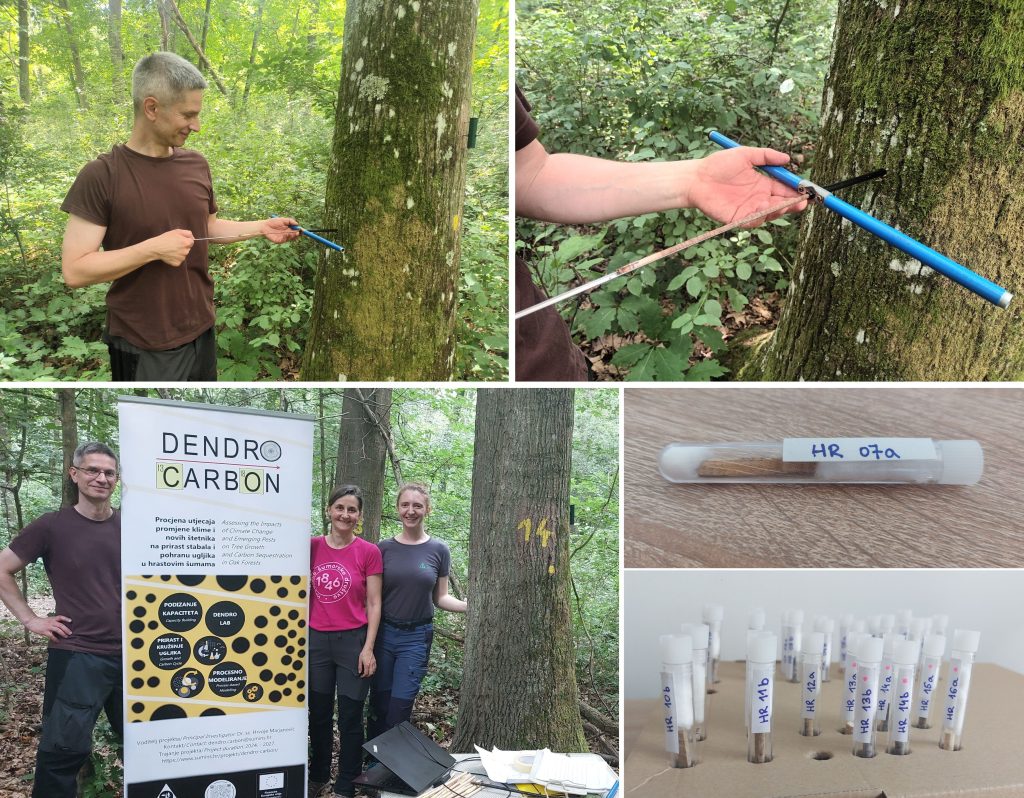
Wood core sampling of pedunculate oak and red oak trees in management unit Haljevo – Kozaračke šume and prepared samples for d13C analysis.
Monitoring Tree Growth
Long-term monitoring of tree growth and carbon fluxes in a pedunculate oak forest in management unit Jastrebarski lugovi has provided insights into the dynamics of CO₂ exchange between the forest and the atmosphere, as well as tree growth trends (Anić et al., 2018). It has also allowed investigation of the temporal evolution of carbon stocks throughout the forest rotation period, based on chronosequence data (Ostrogović Sever et al., 2019; Bitunjac, 2024). The experimental plot system established in Jastrebarski lugovi is unique in Croatia and among the few of its kind worldwide and its scientific value increases with the length of the monitoring period, which has been ongoing since 2008.
Within the Dendro-Carbon project, the equipment in the existing experimental plot system in Jastrebarski lugovi has been upgraded with point dendrometers enabling high-frequency tree growth monitoring at 15-minute intervals. These measurements allow for the reconstruction of radial growth and its correlation with daily meteorological conditions, which is crucial for process-based modelling using models such as Biome-BGCMuSo (Hidy et al., 2012, 2016, 2022).
In addition to the oak chronosequence, point dendrometers have also been installed in Haljevo – Kozaračke šume on pedunculate oak and red oak trees in order to determine differences in growth rates in relation to the increasing intensity of oak lace bug infestations and the resulting leaf damage as the vegetation season progresses.
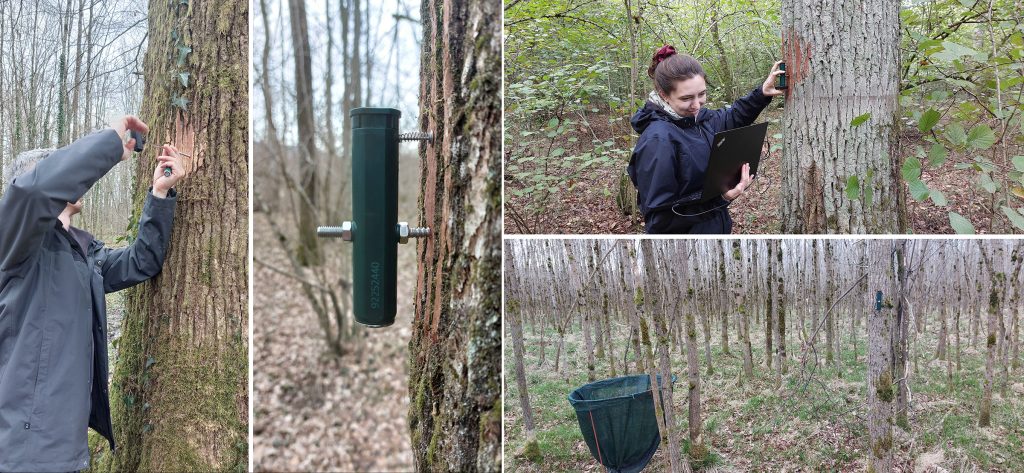
Installation of point dendrometers on pedunculate oak trees in the chronosequence experiment and collection of data from the dendrometers.
DISSEMINATION
Science popularization
The project associates participated in the twelfth Open Door Day of the Croatian Forest Research Institute, held in Jastrebarsko on 15 May 2025. The event, under the theme “Forests – our treasure,” gathered around 1.000 children and students, along with their educators, teachers, and professors from various educational institutions. The associates presented the Dendro-Carbon project using a roll-up banner and conducted a workshop entitled “Forests Mitigate Climate Change.” Workshop participants were provided with an overview of the important concepts of climate change and forest ecosystems, their interconnections, and the role of humans.
The associates also took part in the Science Festival in Zagreb held in May 2025 under the central theme “Networks.” The associates conducted a workshop titled “Discovering Tree Rings – The Mirror of a Tree’s Life,” in which they presented fundamental knowledge about tree annual growth, earlywood and latewood, and the influence of environmental factors on tree growth. Participants had the opportunity to examine wood cores from different tree species under a microscope.
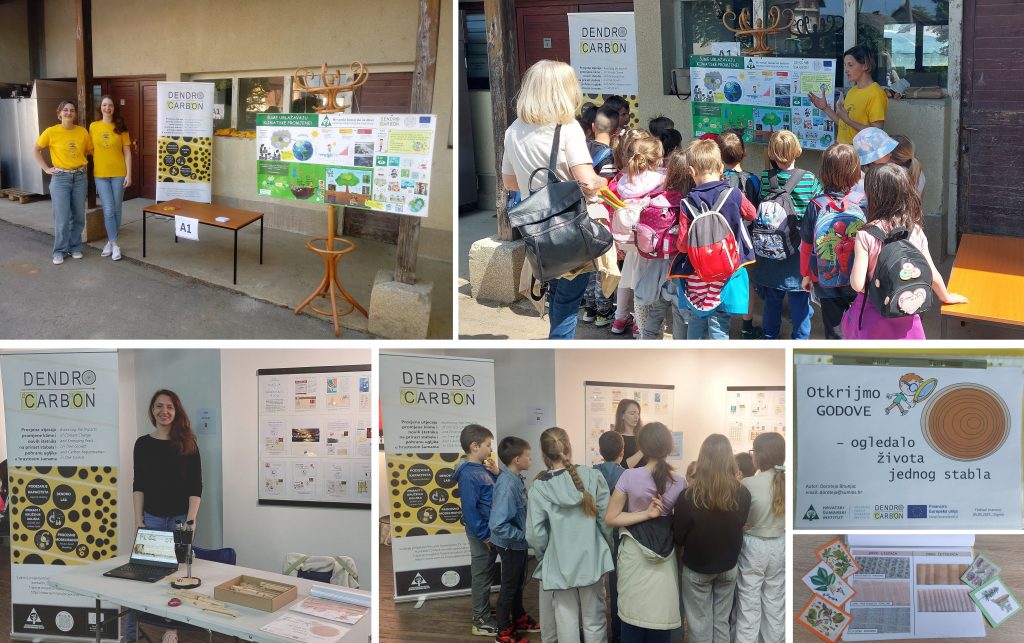
Participation of associates on Open Door Day of Croatian Forest Research Institute in Jastrebarsko (top) and on Science Festival in Zagreb (bottom).
Presentations at scientific conferences

