

Logo of the GREEN HEART OF THE CITY project
Roll-up banner of the GREEN HEART CITY project
Presentations at scientific and professional meetings and conferences
News
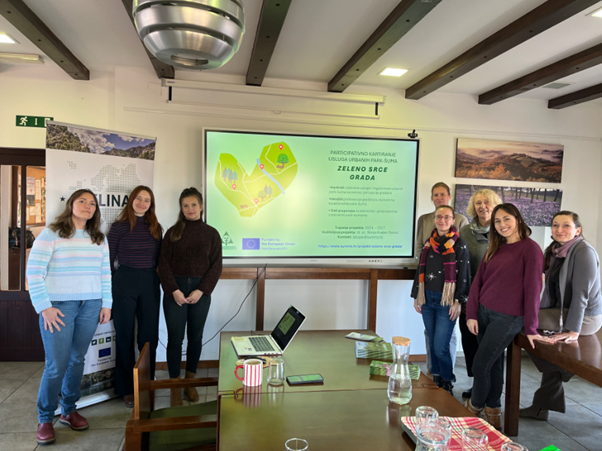
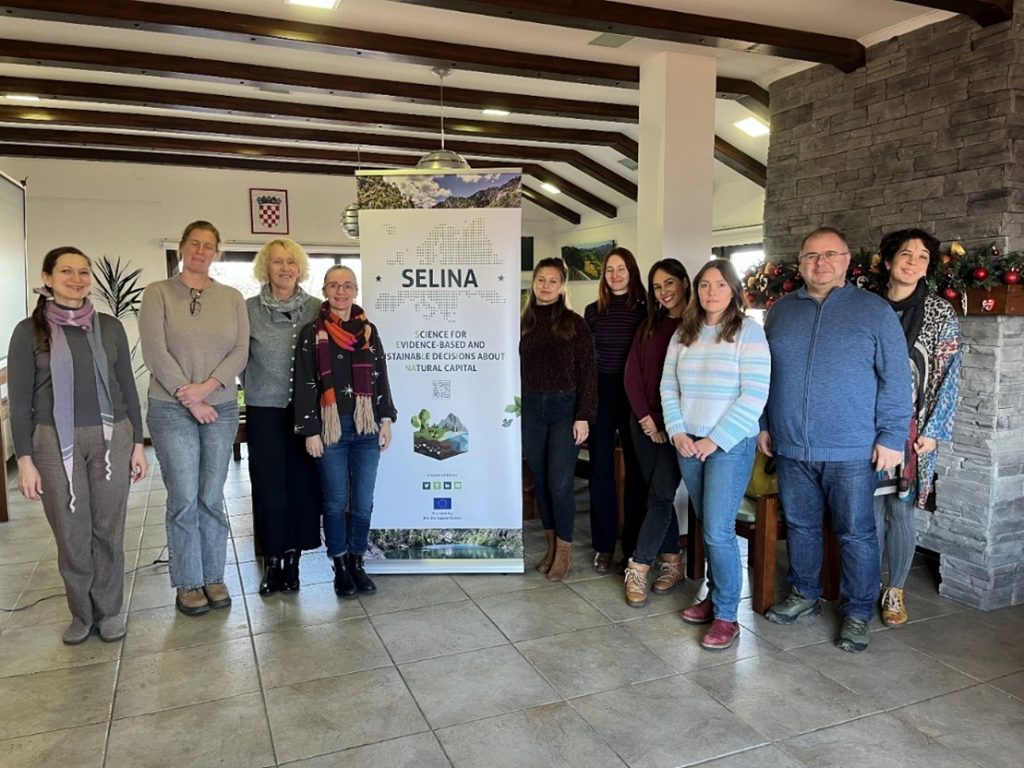
A meeting of the Community of Practice was held on November 28, 2025 at the Slani dol Ecocenter (Public Institution Žumberak-Samoborsko gorje Nature Park).Community of Practice – CoP), established as a part of the Horizon Europe project SELINA.
The members of the Community are representatives of the public and private sectors who work with ecosystem services, ecosystem accounting and biodiversity. The institutions and companies that gathered at the meeting were the Ministry of Environmental Protection and Green Transition, the Public Institution Žumberak-Samoborsko gorje Nature Park, and private companies Geonatura Ltd. and Dvokut Ecro Ltd.
The GREEN HEART OF THE CITY’s project manager, Silvija Krajter Ostoić, PhD, presented the project “Participatory Mapping of Ecosystem Services of Urban Park-Forests” (GREEN HEART OF THE CITY), its activities, results to date and future activities. The presentation elicited great interest among those gathered and an interesting discussion followed, primarily because the members of the Community had no experience with the PPGIS as a method of assessing ecosystem services.
We are delighted to be able to spread the story of participatory mapping to the wider community, and especially to practitioners working in ecosystem services. We would like to thank the SELINA project for the invitation, and the Public Institution Žumberak-Samoborsko gorje Nature Park for its hospitality.
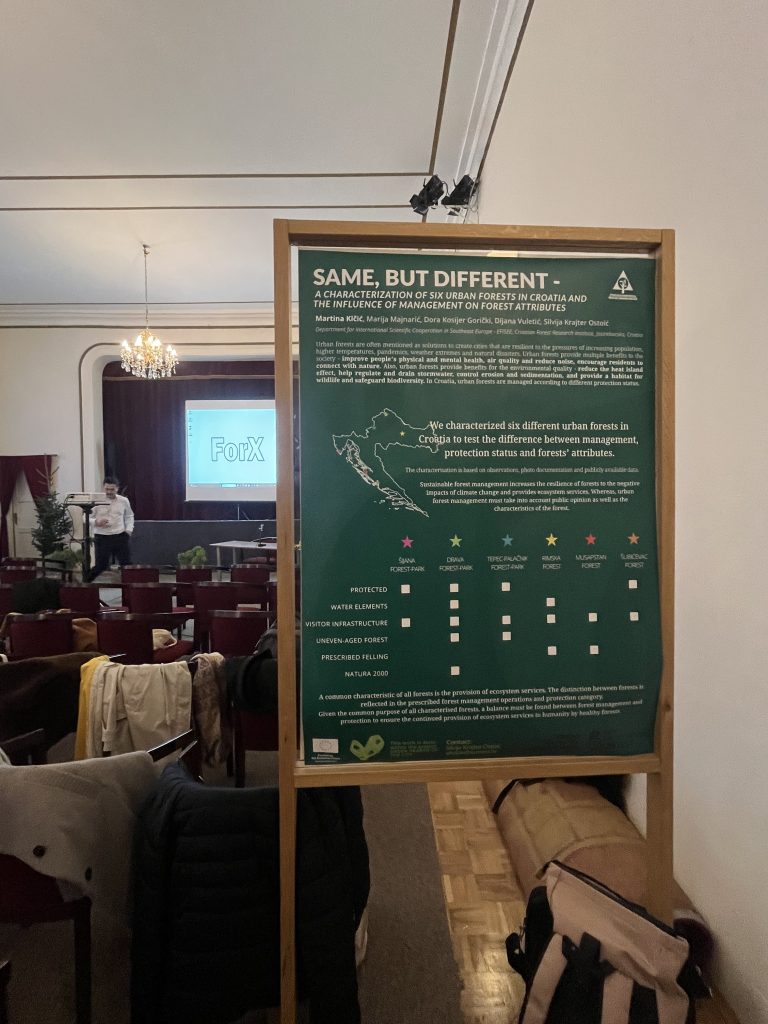
The international scientific conference “Conference for the New Generation of Forest Researchers – ForX2025” was held on 13 and 14 November 2025 at the Cultural Center in Jastrebarsko. The conference, intended for forestry researchers at the beginning of their careers, brought together young researchers from 13 European countries and 23 different institutions.
The conference was organized by the Croatian Forest Research Institute, the Faculty of Forestry and Wood Technology, University of Zagreb, the Academy of Forestry Sciences, the Croatian Forestry Society, the Croatian Chamber of Forestry and Wood Technology Engineers, and Croatian Forests Ltd. company.
Project associate, Martina Kičić, PhD, presented the results of the characterization of forests and forest parks included as study areas in the GREEN HEART OF THE CITY project with a poster presentation entitled “Same, but different – a characterization of six urban forests in Croatia and the influence of management on forest attributes”.
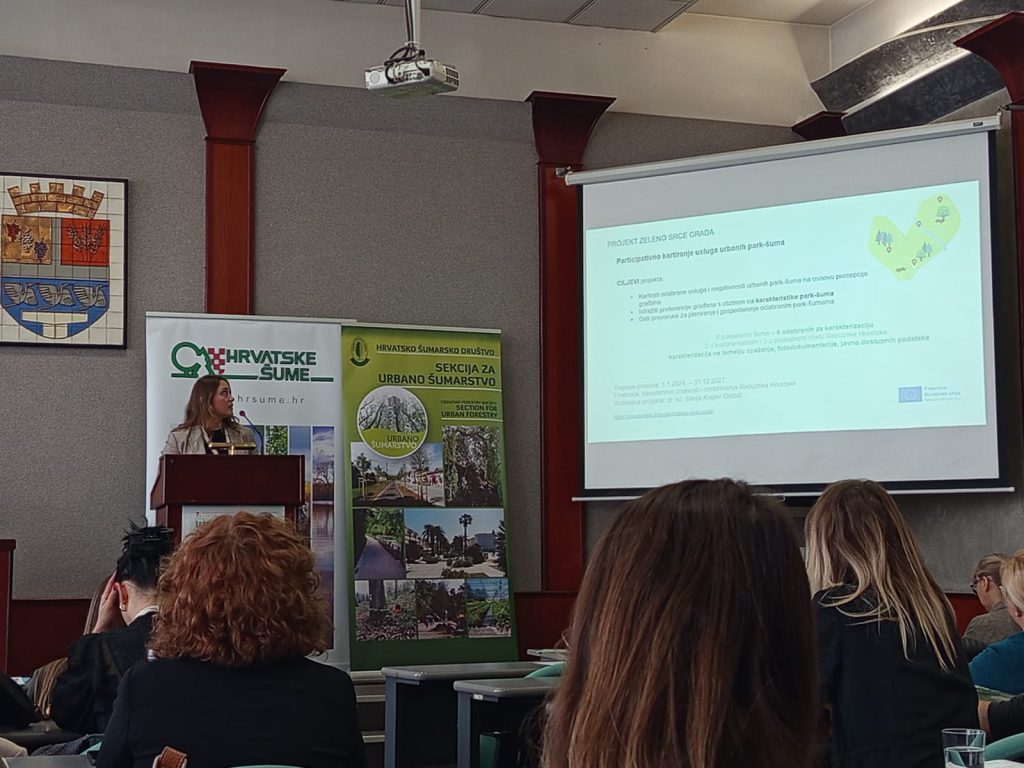
The Annual Conference on Urban Forestry, the 7th Croatian Scientific and Professional Conference on Urban Forestry, was held this year in Vinkovci on October 16th and 17th, 2025.
The conference was organized by the Faculty of Forestry and Wood Technology of the University of Zagreb, the Section for Urban Forestry at the Croatian Forestry Society, Hrvatske šume d.o.o. and the Croatian Forest Research Institute, with co-organizers and sponsors.
On the first day of the conference, Martina Kičić, PhD, gave a presentation entitled “Characterization of forests and forest parks in cities in the Republic of Croatia” in which she presented the results of the analyses of physical characteristics of selected project locations and the work on creating a database of selected forests and forest parks as part of the GREEN HEART OF THE CITY project. In addition to presenting the results of the work, Dr. Kičić also presented the project and announced future activities.
On May 15, 2025, the Croatian Forest Research Institute organized its twelfth Open Day, which this year again attracted around 1,000 visitors – children, students, their educators, teachers and professors, as well as the interested public. This year’s event was held under the motto “Forests – our treasure”, with the aim of promoting science and raising awareness about the importance of forests and the sustainable use of natural resources.
The project Green Heart of the City deals with urban forests and their importance for the lives of citizens. The project explores public perceptions of the services and values that urban forest parks provide, as well as their needs and expectations regarding these spaces.
The project was presented through visual promotional material – a roll-up poster – highlighting the research objectives. The importance of understanding the social perception of urban forests and their role in the lives of urban residents, as well as the research methodology, which includes the use of an online PPGIS questionnaire and data validation through field research, were further explained to visitors in direct communication with the project staff.
During the event, visitors were able to learn about forest ecosystem services, the importance of participatory planning, and the involvement of citizens in decision-making about the development and management of urban green spaces.


The 6th national conference on urban forestry was held in Opatija, attended by about a hundred scientists and experts dealing with the issue of trees and forests in urban areas. The Green Heart of the City project was mentioned during the welcoming speech by Dr. Silvija Krajter Ostoić, project coordinator, on behalf of the director of the Croatian Forest Research Institute, and a roll-up banner of the project was placed on the stage, visible to all participants at all times.


Dr. Silvija Krajter Ostoić held an invited lecture in Ljubljana at the Faculty of Biotechnology, University of Ljubljana, on the occasion of 25th anniversary of urban forestry and 50th anniversary of educational forest trails in Slovenia, 18-19 September 2024. The presentation discussed previous projects of the Croatian Forestry Institute dealing with public perception, their results, as well as future projects and directions in public perception research. During the presentation, the new project Green Heart of the City, which will be implemented in selected forest parks in Croatia, was also mentioned. The conference was attended mainly by forest and education practitioners and scientists.


Dr. Silvija Krajter Ostoić gave an invited lecture at the European Forum on Urban Forestry, where she presented previous and announced new projects of the Croatian Forestry Institute dealing with citizen perception and mapping of urban green infrastructure services. In the lecture, she also announced a new project, Green Heart of the City, which will be implemented in selected park-forests in Croatia. The conference was attended by more than 180 scientists and experts from 29 countries who gathered in Zagreb, 22-25 May 2024.

For the 11th time, on 16 May 2024, the Croatian Forest Research Institute organized an Open Door Day. About 1,100 visitors from 24 educational institutions participated. The Open Day program also included information about the topic and goals of the Green Heart of the City project.
Activities of the GREEN HEART OF THE CITY projectForest parks visited as part of the project
I don’t think there is a person in Croatia who hasn’t at least heard of the popular Croatian movie One Song a Day Takes Mischief Away (Tko pjeva, zlo ne misli). But did you know that part of that film was filmed at Anindol (the location of the Tepec-Palačnik forest park) in Samobor? A few minutes from the city center, you can quickly immerse yourself in the peace and quiet of the forest park. As part of the Green Heart of the City project, we decided to visit this forest park in June 2025 in order to find locations for the implementation of the project. It was a beautiful day for a walk. We met only a few dog walkers and an elderly lady who was walking alone in the forest. Maybe because it was a weekday. At the foot of the hill by the stream, however, there were many more walkers. The forest park has several entrances and steep paths that are not very pleasant for walking. There are some parts that are easier to master, such as the Tancalište (Dance Hall) and the Šmidhenove stube (Šmidhen Steps), as well as the path to the old town of Samobor. There was no trash in the forest itself, not even in the old town, which surprised us a bit, because trash is, unfortunately, an inevitable part of our forests. In the forest, there are many fallen trees, branches and fallen stumps, which stand as witnesses of the storm that hit Croatia in 2023. The Tepec-Palačnik Forest Park is interesting for the implementation of this project because it is rich in cultural ecosystem services – apart from the obvious recreational role, it is important for cultural identity and heritage, has an educational role, and provides a habitat for flora and fauna. The real green heart of the city!
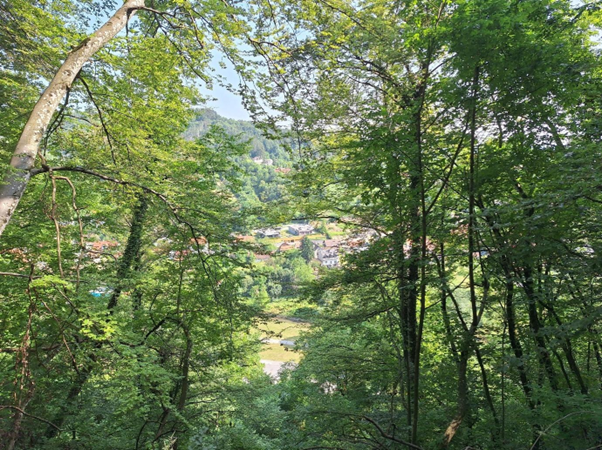
View of Samobor from the forest (Photo: Silvija Krajter Ostoić)
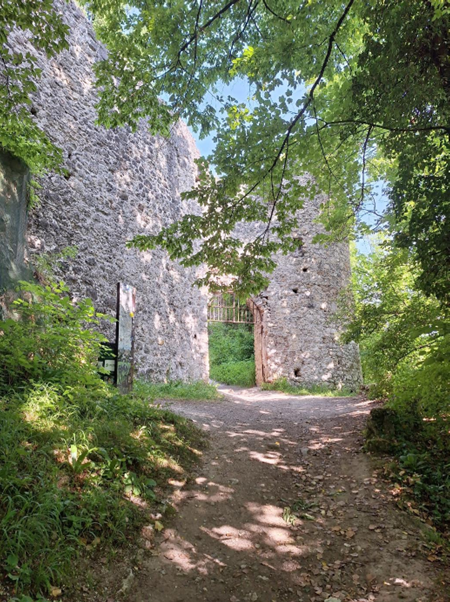
The old town of Samobor (Photo: Silvija Krajter Ostoić)
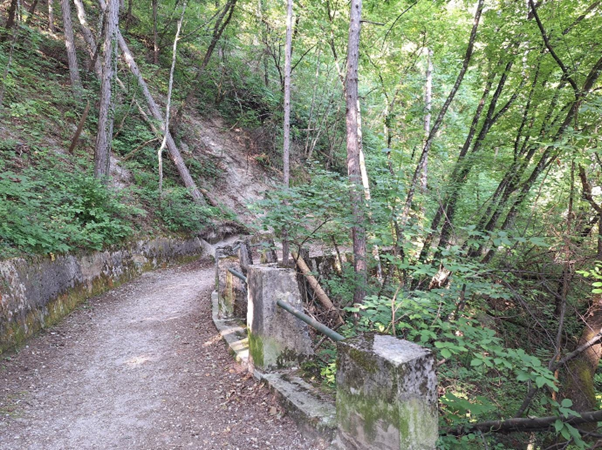
Promenade in the forest park (Photo: Silvija Krajter Ostoić)
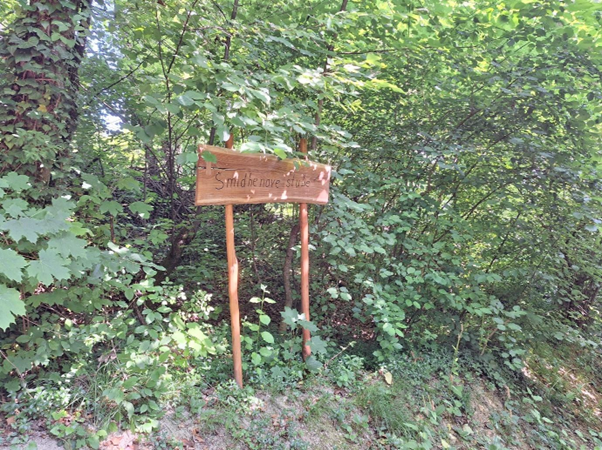
Example of wooden boards with location name (Photo: Silvija Krajter Ostoić)
Šijana Forest Park is located in the city district of Pula with the same name and was protected in 1964. It is managed by the Public Institution for protected nature areas of the Istrian County Natura Histrica and managed by Croatian Forests Ltd., the forest office Pula. The size of the forest is 152.13 ha. It is a forest of honey oak and white hornbeam, in which exotic species are also planted. In the past, it was used for the production of wood for shipbuilding, but later it was developed as a recreational and picnic area. In the forest, there are trails of different lengths and levels of difficulty, a children’s playground and an exercise area. The old Austro-Hungarian bunker was renovated in 2022. It hosts various public events. During the visit, we met walkers, cyclists and people exercising in nature. There is a restaurant (café) next to the central meadow.

Information board at the entrance to the forest park

Detail from the Šijana park-forest

Researchers in action
For the purpose of selecting locations for conducting research as part of the Green Heart of the City project, a field tour of the Šubićevac Forest Park in Šibenik was conducted. The forest is located in the neighbourhood of the same name within the city of Šibenik. It is part of the protected landscape of Gvozdenovo-Kamenar. The forest is managed by the Croatian Forests Ltd., and is managed by the Public Institution Nature of Šibenik-Knin County. There are recreational facilities within Šubićevac, and it is a very popular place for recreation of the local population. Recreational facilities include a children’s playground, bocce ball court, a trim track and bike path, while on the Šubićevac trail, you can see a cave and a well. At the top of the hill is a viewpoint with a view of the city, the sea and the islands.


Trim track

Part of the trim track with educational content
For the purpose of selecting locations for conducting research as part of the Green Heart of the City project, a field tour of the Župetnica forest park in Križevci was conducted. Given that it is a protected area, it is governed by the Public Institution Koprivnica-Križevci county, and the forest is managed by the Croatian Forests Ltd. company, forest office Križevci. Its size is 38 ha, and it was declared a forest park in 1983. Citizens use it mainly for walking and recreation. It has no recreational facilities. Remains of the former trim track are visible in the forest, which is now completely neglected. There is a guerrilla mountain bike trail – built by users without of authorisation. At the beginning of the forest, there are also the remains of a hunting lodge with a restaurant, which was once an important place for gatherings and celebrations of the local population, but after passing into private hands, it was left to decay and is now a complete ruin. In the forest, there is a 50-year-old conifer culture that is declining. Only sanitary felling is carried out in the forest. During our stay in the forest, we met only a cyclist, using the forest as a shortcut.

Entrance to the forest park Župetnica

Guerrilla trail building – mountain biking trail built by users

Remains of the former trim track

The remains of a former hunting lodge

Poor health status of conifer culture
For the purpose of selecting locations for conducting research as part of the Green Heart of the City project, a field tour of the Rimska šuma (Roman Forest) in Daruvar was conducted. The Roman Forest is an important place for recreation for the citizens of Daruvar. Although it has the characteristics of a forest park, it is not formally protected as such. It is oak and common hornbeam forest with beech. The forest is managed by the Croatian Forests Ltd. Company, forest office Daruvar. Only sanitary logging is carried out in the forest. Near the forest is the central town square, the famous Daruvar spa and wellness and the recently opened Veterans Centre, which serves for the rehabilitation of veterans of the Homeland War. In the forest, there are also culturally interesting elements such as Roman remains, the Jewish cemetery and the Roman (Julian) spring. The latter is also associated with a legend saying that anyone who drinks water from that source will soon fall in love. An educational trail with 19 panels was opened in the forest in 2014, from which you can learn about the natural and cultural sights of the Roman Forest. The goal of the educational trail was to enrich the recreational and tourist facilities in the town of Daruvar.

Information panel at the beginning of the trail

Walking path inside the Roman Forest

Autumn view of the forest
In order to select locations for conducting research as part of the Green Heart of the City project, a field tour of the Dravska forest park in Varaždin was conducted. It is located along the Drava River and is a favourite recreational area of Varaždin residents. The Dravska forest park is a protected area managed by the Public Institution Priroda of the Varaždin County, and the forest is managed by Hrvatske šume d.o.o. It is part of the Mura-Drava regional park, the cross-border Mura-Drava-Danube biosphere reserve under the protection of UNESCO and the Natura 2000 ecological network. In the part of the forest, there are recreational and educational facilities, such as a children’s playground, an educational trail about the flora and fauna, as well as a viewpoint next to the wetland habitat. These are the facilities that certainly contribute to the visitation of the forest park and influence the interest and movement of visitors in the forest. For informational and educational purposes, an interesting application, Explore the Forest, was created.

At the entrance to the forest park

Information board at the entrance to the forest park

An element of the educational path

An element of a children’s playground with educational content

Rules of conduct for visitors

Viewpoint in the forest
For the purpose of selecting locations for research as part of the Green Heart of the City project, a field tour of the Musapstan forest in Zadar was conducted. The forest is state-owned and managed by the Croatian Forests Ltd. company, the forest office Zadar. We met with the head of the forest office, Mr. Mislav Maršić, with whom we went around the forest. Musapstan has the physical characteristics of a forest park, that is, a forest intended for the recreation of citizens. An educational trail and recreational facilities, such as a children’s playground and an outdoor exercise field, were arranged with the funds of the European Union.The Faculty of Forestry and Wood Technology of the University of Zagreb made a study on the future recreational and touristic development of the forest. Musapstan is a forest dominated by pine, which was planted by the Italians. The problem is the absence of natural regeneration of the Pinus pinea due to climate change and the fact that it is on the edge of its natural geographical distribution. To keep it, all that remains is to replace it by planting seedlings. The stone pine has a distinctive umbrella-shaped crown and is aesthetically attractive. According to Mr. Maršić, the citizens are very attached to its presence in the forest and therefore insist on keeping it even though there is no natural regeneration. The forest is managed by using uneven-age forest management.

At the entrance to the Musapstan forest

Forest view

The beginning of the educational and trim track

An element of a children’s playground

Infrastructure for forestry pedagogy

Recreational infrastructure

Forest regeneration
For the purpose of selecting locations for conducting research as part of the Green Heart of the City project, a field tour of the forest park Japlenški vrh in Delnice was conducted. The popular recreational point for citizens of Delnice is governed by the Public Institution for Nature Protection of the Primorje-Gorski Kotar County, and the forest is managed by Croatian Forests Ltd. company. Only sanitary felling is carried out (removal of trees for health reasons). After talking with the employees of the regional forest office Delnice, we toured the forest park together. At the entrance to the forest, there is a popular restaurant and lodging, as well as a viewpoint with a view of the city. Within the forest, there is a trail with an educational path. There is no other recreational infrastructure. During the visit, we did not encounter any visitors, even though it was a beautiful and sunny day.

Viewpoint at the entrance to the forest park Japlenški vrh

Information board about the forest park Japlenški vrh

View of the forest park Japlenški vrh

A sign for a cycling route


